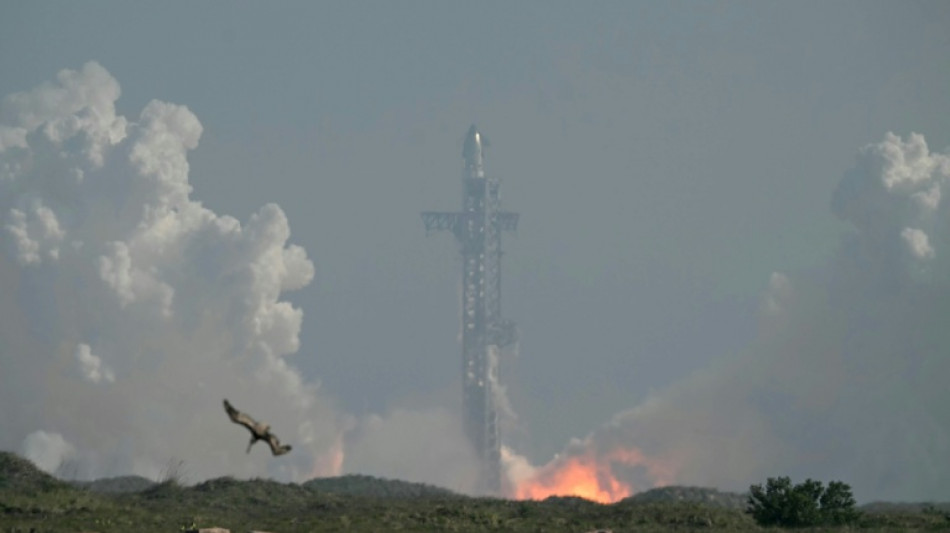
SpaceX sends Starship rocket sailing into space / Photo: RONALDO SCHEMIDT - AFP

 London
 17 °C
17 °C

 Manchester
16 °C
Manchester
16 °C
 Glasgow
13 °C
Glasgow
13 °C
 Dublin
17 °C
Dublin
17 °C
 Belfast
16 °C
Belfast
16 °C
 Washington
18 °C
Washington
18 °C
 Denver
22 °C
Denver
22 °C
 Atlanta
22 °C
Atlanta
22 °C
 Dallas
33 °C
Dallas
33 °C
 Houston Texas
 35 °C
35 °C
 New Orleans
31 °C
New Orleans
31 °C
 El Paso
 24 °C
24 °C
 Phoenix
27 °C
Phoenix
27 °C
 Los Angeles
 27 °C
San Diego
26 °C
San Francisco
24 °C
Chicago
20 °C
Minneapolis
19 °C
Seattle
15 °C
Portland
18 °C
Salt Lake City
25 °C
Las Vegas
27 °C
San Diego
26 °C
San Francisco
24 °C
Chicago
20 °C
Minneapolis
19 °C
Seattle
15 °C
Portland
18 °C
Salt Lake City
25 °C
Las Vegas
 33 °C
Miami
32 °C
Jacksonville
25 °C
San Antonio
34 °C
Bermuda
26 °C
Nassau
19 °C
Iqaluit
5 °C
Yellowknife
9 °C
Anchorage
8 °C
Fairbanks
4 °C
Barrow
-2 °C
Calgary
15 °C
Edmonton
24 °C
Winnipeg
17 °C
Goose Bay
19 °C
Halifax
16 °C
Boston
18 °C
Ottawa
21 °C
Toronto
18 °C
Detroit
20 °C
Cleveland
21 °C
New York
19 °C
Baltimore
19 °C
Philadelphia
18 °C
Nuuk (Godthåb)
4 °C
Hong Kong
33 °C
Miami
32 °C
Jacksonville
25 °C
San Antonio
34 °C
Bermuda
26 °C
Nassau
19 °C
Iqaluit
5 °C
Yellowknife
9 °C
Anchorage
8 °C
Fairbanks
4 °C
Barrow
-2 °C
Calgary
15 °C
Edmonton
24 °C
Winnipeg
17 °C
Goose Bay
19 °C
Halifax
16 °C
Boston
18 °C
Ottawa
21 °C
Toronto
18 °C
Detroit
20 °C
Cleveland
21 °C
New York
19 °C
Baltimore
19 °C
Philadelphia
18 °C
Nuuk (Godthåb)
4 °C
Hong Kong
 28 °C
Singapore
28 °C
Singapore
 28 °C
Melbourne
30 °C
Canberra
11 °C
Adelaide
17 °C
Darwin
23 °C
Perth
14 °C
Fort Worth
33 °C
Honolulu
27 °C
Sydney
16 °C
Johannesburg
18 °C
Dubai
33 °C
Mumbai
29 °C
Zürich
28 °C
Melbourne
30 °C
Canberra
11 °C
Adelaide
17 °C
Darwin
23 °C
Perth
14 °C
Fort Worth
33 °C
Honolulu
27 °C
Sydney
16 °C
Johannesburg
18 °C
Dubai
33 °C
Mumbai
29 °C
Zürich
 17 °C
Tokyo
23 °C
Seoul
17 °C
Delhi
28 °C
Beijing
19 °C
Riyadh
34 °C
Prague
11 °C
Pennsylvania
20 °C
Valletta
17 °C
Tokyo
23 °C
Seoul
17 °C
Delhi
28 °C
Beijing
19 °C
Riyadh
34 °C
Prague
11 °C
Pennsylvania
20 °C
Valletta
 24 °C
Manama
33 °C
Warsaw
12 °C
Stockholm
12 °C
24 °C
Manama
33 °C
Warsaw
12 °C
Stockholm
12 °C
The latest edition of SpaceX's Starship soared through the Texas skies Friday after the company's initial launch attempt was called off over technical issues the evening prior.
The mammoth rocket blasted off into space at just after 5:30 pm local time (2230 GMT), kicking off the highly anticipated test flight that comes as Elon Musk's space company prepares a buzzy initial public offering.
The Super Heavy booster separated from the upper stage as expected, but company spokesperson Dan Huot said on the livestream of the event that the booster failed to complete its so-called boost-back burn.
The booster fell swiftly back to Earth uncontrolled into Gulf waters. SpaceX wasn't planning to recapture the booster anyway, but was still hoping for a precision return.
The vehicle was coasting through space but was not in exactly the correct orbit after one of its engines malfunctioned. It had burned its remaining five engines slightly longer to compensate.
"I wouldn't call it nominal orbital insertion," Huot said, but said that it was on a previously analyzed trajectory that was "within bounds."
Cheers rang out among SpaceX employees as the spacecraft began delivering a set of mock satellites, as well as two "specially modified Starlink satellites" outfitted with cameras, which will analyze the spacecraft's heat shield.
- Biggest ship yet -
Thursday's aborted trial featured several rounds of stopping and starting the countdown clock.
After it was determined that the last-minute glitches could not be addressed in time, Musk quickly posted on X that "the hydraulic pin holding the tower arm in place did not retract."
The thwarted attempt at the south Texas launchpad on Thursday came after SpaceX filed with US financial regulators to go public, likely in June, in what is expected to become a record IPO.
The launch offered a live-streamed look at SpaceX's progress in developing its enormous Starship rocket, a key component of its own ambitious plans as well as US space agency NASA's program to return to the Moon.
Friday marks Starship's 12th flight overall, but the first in seven months.
The latest design is bigger than its predecessor, standing at just over 407 feet (124 meters) when fully stacked.
The company, which aims to make Starship a fully reusable system, says the mission's primary goal is to demonstrate its redesigns in flight.
The most recent Starship missions have gone down as successful.
But previous tests have ended in spectacular explosions, including twice over the Caribbean and once after reaching space. Last June, the upper stage blew up in a ground test.
- NASA administrator onsite -
There's a lot riding on SpaceX's progress: the company is under contract with NASA to produce a modified version of Starship to serve as a lunar landing system.
The US space agency's Artemis program aims to return humans to the Moon, as China forges ahead with a rival effort that's targeting 2030 for its first crewed mission.
Ahead of launch, NASA Administrator Jared Isaacman appeared during the pre-launch SpaceX program and said "we're looking forward to seeing this fly, because hopefully at some point in the not too distant future we're going to join up in Earth orbit."
Both SpaceX and rival Blue Origin, the Jeff Bezos-owned firm also vying to develop a lunar lander, have realigned their strategies to prioritize projects related to Moon missions.
NASA is aiming to test an in-orbit rendezvous between its spacecraft and one or two lunar landers in 2027 and carry out a crewed lunar landing before the end of 2028.
But a lot needs to happen before then -- and industry experts have voiced repeated skepticism that SpaceX and Blue Origin can achieve benchmarks in time.
(N.Miller--TAG)