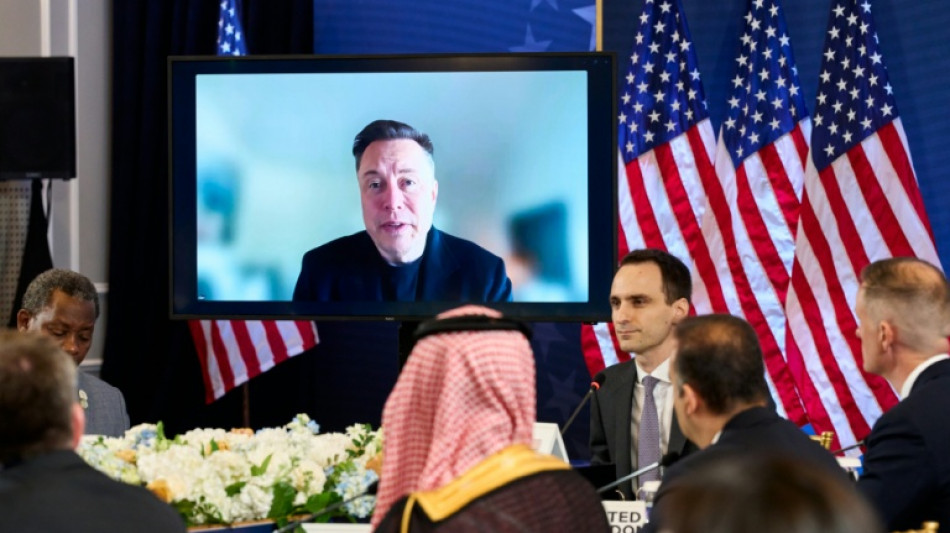
Musk defends AI data centers, slams EU rules at G20 / Photo: Matt RAMEY - AFP

 London
 23 °C
23 °C

 Manchester
 19 °C
19 °C
 Glasgow
18 °C
Glasgow
18 °C
 Dublin
21 °C
Dublin
21 °C
 Belfast
18 °C
Belfast
18 °C
 Washington
 30 °C
30 °C
 Denver
18 °C
Denver
18 °C
 Atlanta
28 °C
Atlanta
28 °C
 Dallas
30 °C
Dallas
30 °C
 Houston Texas
29 °C
Houston Texas
29 °C
 New Orleans
 30 °C
30 °C
 El Paso
24 °C
El Paso
24 °C
 Phoenix
27 °C
Phoenix
27 °C
 Los Angeles
19 °C
San Diego
20 °C
San Francisco
16 °C
Chicago
28 °C
Minneapolis
23 °C
Seattle
14 °C
Portland
16 °C
Salt Lake City
17 °C
Las Vegas
26 °C
Miami
Los Angeles
19 °C
San Diego
20 °C
San Francisco
16 °C
Chicago
28 °C
Minneapolis
23 °C
Seattle
14 °C
Portland
16 °C
Salt Lake City
17 °C
Las Vegas
26 °C
Miami
 28 °C
Jacksonville
29 °C
San Antonio
28 °C
Bermuda
30 °C
Nassau
23 °C
Iqaluit
12 °C
Yellowknife
14 °C
Anchorage
28 °C
Jacksonville
29 °C
San Antonio
28 °C
Bermuda
30 °C
Nassau
23 °C
Iqaluit
12 °C
Yellowknife
14 °C
Anchorage
 4 °C
Fairbanks
2 °C
Barrow
2 °C
Calgary
11 °C
Edmonton
29 °C
Winnipeg
17 °C
Goose Bay
19 °C
Halifax
20 °C
Boston
20 °C
Ottawa
19 °C
Toronto
22 °C
Detroit
27 °C
Cleveland
28 °C
New York
24 °C
Baltimore
30 °C
Philadelphia
26 °C
Nuuk (Godthåb)
8 °C
Hong Kong
4 °C
Fairbanks
2 °C
Barrow
2 °C
Calgary
11 °C
Edmonton
29 °C
Winnipeg
17 °C
Goose Bay
19 °C
Halifax
20 °C
Boston
20 °C
Ottawa
19 °C
Toronto
22 °C
Detroit
27 °C
Cleveland
28 °C
New York
24 °C
Baltimore
30 °C
Philadelphia
26 °C
Nuuk (Godthåb)
8 °C
Hong Kong
 26 °C
Singapore
26 °C
Singapore
 29 °C
Melbourne
29 °C
Canberra
12 °C
Adelaide
15 °C
Darwin
26 °C
Perth
12 °C
Fort Worth
29 °C
Honolulu
29 °C
Melbourne
29 °C
Canberra
12 °C
Adelaide
15 °C
Darwin
26 °C
Perth
12 °C
Fort Worth
29 °C
Honolulu
 25 °C
Sydney
18 °C
Johannesburg
26 °C
Dubai
37 °C
Mumbai
29 °C
Zürich
26 °C
Tokyo
25 °C
Seoul
22 °C
Delhi
32 °C
Beijing
18 °C
Riyadh
43 °C
Prague
23 °C
Pennsylvania
26 °C
Valletta
32 °C
Manama
37 °C
Warsaw
21 °C
Stockholm
20 °C
25 °C
Sydney
18 °C
Johannesburg
26 °C
Dubai
37 °C
Mumbai
29 °C
Zürich
26 °C
Tokyo
25 °C
Seoul
22 °C
Delhi
32 °C
Beijing
18 °C
Riyadh
43 °C
Prague
23 °C
Pennsylvania
26 °C
Valletta
32 °C
Manama
37 °C
Warsaw
21 °C
Stockholm
20 °C
Elon Musk on Tuesday urged the G20 to tread softly on regulating tech and AI, saying European-style rules inhibit innovation.
Musk also made a defense of building data centers to meet the needs of the AI revolution, amid a growing backlash against their construction in the United States ahead of midterm elections later this year.
The Tesla and SpaceX chief was participating virtually in a tech-focused G20 meeting in North Carolina amid a global debate on how governments should address the dangers and promise of artificial intelligence.
The Trump administration is largely committed to a hands-off approach that would leave the industry to find ways to self-regulate, even as companies race furiously to stay ahead in AI despite the risks.
In a sign that his administration is loath to create any obstacle for the AI industry, President Donald Trump on Monday attacked opponents of artificial intelligence data centers, saying they would end up "backwards and poor" and were helping rival China.
At the meeting in Chapel Hill, home to the University of North Carolina, a leading US research hub, Musk said the AI data centers were badly needed to fill a "power shortfall" in meeting AI needs.
He insisted that data center builders should be paying their fair share of tax, but that the technology world was in urgent need of the AI capacity the data centers provide.
With ministers from EU members France, Italy and Germany sitting in the room -- as well as EU tech chief Henna Virkkunen -- Musk slammed EU policies for inhibiting technology.
"You have to have an environment that's relatively free of regulation, meaning that new things must be default legal as opposed to default illegal," Musk said.
"In the EU, for example, we find that the regulation level is extraordinarily high, and things are generally default illegal, and this inhibits progress with new technologies," he added.
"It doesn't ultimately stop it, but it slows it down quite considerably," he said, in arguments that EU officials in Brussels firmly reject.
The United States holds the rotating G20 presidency this year and is hosting a series of ministerial meetings ahead of a leaders' summit that Trump will convene on December 14-15 at his Trump National Doral resort in Miami.
Washington has framed its host year around limiting regulatory burdens and promoting new technologies.
The Chapel Hill meeting is organized by White House Office of Science and Technology Policy Director Michael Kratsios and Commerce Secretary Howard Lutnick, who want attendees to commit to light-touch AI regulation.
The meeting is spread over two days, with Nvidia's Jensen Huang and OpenAI's Sam Altman expected in person on Wednesday for fireside chats with Lutnick.
Google DeepMind boss Demis Hassabis and Meta chief Mark Zuckerberg will also participate virtually.
At the meeting, Kratsios is defending something called the Carolina Principles, a policy under which governments commit to avoid creating too many rules for the deployment of AI.
- 'Disaster' -
The meeting takes place just weeks after OpenAI revealed that testing of its AI models went seriously awry, when automonous AI programs -- known as AI agents -- operating without human supervision went onto the internet and broke into a website.
The incident is still causing major ructions in Silicon Valley, with some, including Microsoft founder Bill Gates, calling for the industry and officials to urgently come up with ways to govern the development of the sector.
In the fallout, Hassabis in July called for the United States to create an organization that would test the most powerful AI systems before they can be released to the public.
Speaking at the G20, Trump's former AI czar David Sacks -- who still holds considerable sway with the White House -- said he was against the creation of any such bodies, as they would stifle AI's development.
"There's already, I think, a thicket of laws that apply to AI," Sacks said during his own virtual address to the G20 ministers.
Having AI's cutting edge models regulated as closely as the manufacturing of airplanes or drugs "would be a disaster," he said.
(R.White--TAG)