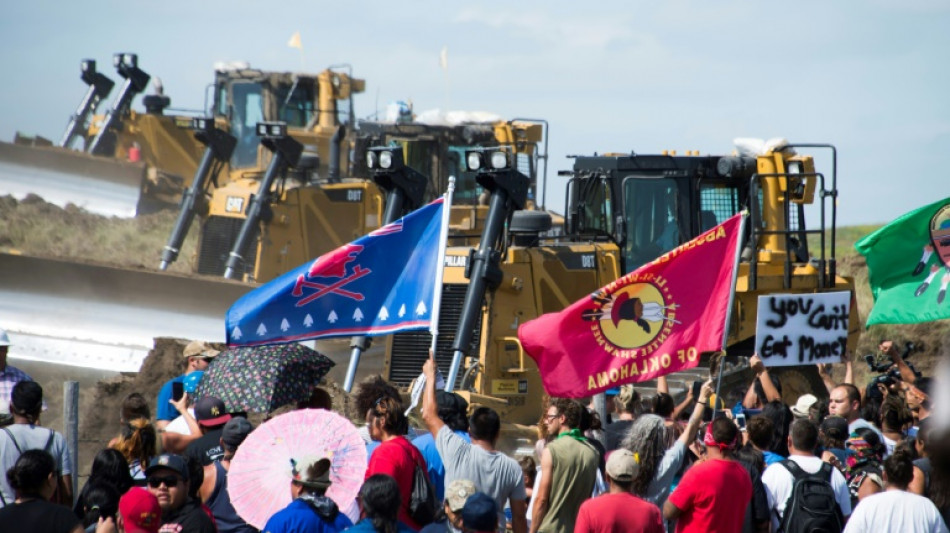
Court orders Greenpeace to pay $345 mn to US oil pipeline company / Photo: Robyn BECK - AFP/File

 London
 36 °C
36 °C

 Manchester
 32 °C
32 °C
 Glasgow
 29 °C
29 °C
 Dublin
27 °C
Dublin
27 °C
 Belfast
26 °C
Belfast
26 °C
 Washington
30 °C
Washington
30 °C
 Denver
22 °C
Denver
22 °C
 Atlanta
32 °C
Atlanta
32 °C
 Dallas
32 °C
Dallas
32 °C
 Houston Texas
33 °C
Houston Texas
33 °C
 New Orleans
33 °C
New Orleans
33 °C
 El Paso
26 °C
El Paso
26 °C
 Phoenix
30 °C
Phoenix
30 °C
 Los Angeles
22 °C
San Diego
22 °C
San Francisco
17 °C
Chicago
25 °C
Minneapolis
23 °C
Seattle
18 °C
Portland
Los Angeles
22 °C
San Diego
22 °C
San Francisco
17 °C
Chicago
25 °C
Minneapolis
23 °C
Seattle
18 °C
Portland
 17 °C
Salt Lake City
23 °C
Las Vegas
28 °C
Miami
33 °C
Jacksonville
32 °C
San Antonio
31 °C
Bermuda
28 °C
Nassau
28 °C
Iqaluit
3 °C
Yellowknife
19 °C
Anchorage
15 °C
Fairbanks
13 °C
Barrow
9 °C
Calgary
11 °C
Edmonton
28 °C
Winnipeg
22 °C
Goose Bay
23 °C
Halifax
26 °C
Boston
27 °C
Ottawa
22 °C
Toronto
25 °C
Detroit
26 °C
Cleveland
24 °C
New York
29 °C
Baltimore
30 °C
Philadelphia
28 °C
Nuuk (Godthåb)
17 °C
Salt Lake City
23 °C
Las Vegas
28 °C
Miami
33 °C
Jacksonville
32 °C
San Antonio
31 °C
Bermuda
28 °C
Nassau
28 °C
Iqaluit
3 °C
Yellowknife
19 °C
Anchorage
15 °C
Fairbanks
13 °C
Barrow
9 °C
Calgary
11 °C
Edmonton
28 °C
Winnipeg
22 °C
Goose Bay
23 °C
Halifax
26 °C
Boston
27 °C
Ottawa
22 °C
Toronto
25 °C
Detroit
26 °C
Cleveland
24 °C
New York
29 °C
Baltimore
30 °C
Philadelphia
28 °C
Nuuk (Godthåb)
 7 °C
Hong Kong
30 °C
Singapore
29 °C
Melbourne
32 °C
Canberra
7 °C
Hong Kong
30 °C
Singapore
29 °C
Melbourne
32 °C
Canberra
 2 °C
Adelaide
12 °C
Darwin
23 °C
Perth
11 °C
Fort Worth
33 °C
Honolulu
26 °C
Sydney
10 °C
Johannesburg
11 °C
Dubai
40 °C
Mumbai
2 °C
Adelaide
12 °C
Darwin
23 °C
Perth
11 °C
Fort Worth
33 °C
Honolulu
26 °C
Sydney
10 °C
Johannesburg
11 °C
Dubai
40 °C
Mumbai
 28 °C
Zürich
35 °C
Tokyo
24 °C
Seoul
28 °C
Zürich
35 °C
Tokyo
24 °C
Seoul
 24 °C
Delhi
30 °C
Beijing
22 °C
Riyadh
24 °C
Delhi
30 °C
Beijing
22 °C
Riyadh
 42 °C
Prague
27 °C
Pennsylvania
28 °C
Valletta
31 °C
Manama
36 °C
Warsaw
22 °C
Stockholm
25 °C
42 °C
Prague
27 °C
Pennsylvania
28 °C
Valletta
31 °C
Manama
36 °C
Warsaw
22 °C
Stockholm
25 °C
Greenpeace must pay $345 million in damages to the operator of the US oil pipeline it protested, a North Dakota court ordered Friday.
The decision finalizes this phase of the explosive, yearslong case that has pitted the environmental organization against the company Energy Transfer, opening the door to an appeals process in the closely watched legal saga.
The Dallas-based energy conglomerate accused Greenpeace of orchestrating violence and defamation during the controversial construction of the Dakota Access Pipeline nearly a decade ago.
A jury last year took their side, awarding more than $660 million in damages across three Greenpeace entities, citing charges including trespass, nuisance, conspiracy and deprivation of property access.
Judge James Gion of North Dakota cut those damages in half, determining some damages had been counted twice.
But the sum remains staggering.
Greenpeace categorically rejects the accusations, denouncing the proceedings as abusive and a means to silence dissent.
Legal experts and advocacy groups alike have closely followed the case, given its potentially far-reaching implications for protest mobilization and advocacy movements.
Greenpeace has indicated its intention to appeal and has repeatedly stated it cannot pay hundreds of millions of dollars.
"This legal fight is far from over," Kristin Casper, Greenpeace International general counsel, said in a statement to AFP.
"We will be requesting a new trial and, failing that, will appeal the judgment to the Supreme Court of North Dakota, where Greenpeace International and the US Greenpeace entities have solid arguments for the dismissal of all legal claims against us."
Energy Transfer, meanwhile, has objected to the halving of its award.
Michael Gerrard, director of Columbia Law School's climate change law center, told AFP the judgment was "devastating."
"It is very bad not only for Greenpeace, but for the global environmental movement," he said.
- Global impact -
The case could have ripple effects worldwide.
When the initial verdict dropped last year, environmental defenders rallied around Greenpeace, denouncing the verdict as a chilling attack on climate action around the globe.
"Fossil fuel companies invest billions in new oil and gas while they spread misinformation, lobby against climate policies, and attempt to silence dissent against their destructive business model," Allie Rosenbluth, the US campaign manager of Oil Change International, said in a statement to AFP.
"They must not be allowed to act with impunity. These bullying lawsuits won't stop people from standing up to Big Oil to protect their communities and the planet."
At the heart of the North Dakota court battle was the Dakota Access Pipeline, where from 2016 to 2017 the Standing Rock Sioux Tribe led one of the largest anti-fossil-fuel protests in US history.
The demonstrations saw hundreds arrested and injured, drawing the attention of the United Nations, which raised concerns over potential violations of Indigenous sovereignty.
Despite the protests, the pipeline -- designed to transport fracked crude oil to refineries and on to global markets -- became operational in 2017.
Energy Transfer, however, continued its legal pursuit of Greenpeace.
After its federal lawsuit was dismissed, it shifted its legal strategy to the state courts in North Dakota, one of the minority of US states without protections against so-called "Strategic Lawsuits Against Public Participation" or SLAPPs.
Throughout the yearslong legal fight, ET's billionaire CEO Kelcy Warren, a major donor to President Donald Trump, was open about his motivations.
His "primary objective" in suing Greenpeace, he said in interviews, was not just financial compensation but to "send a message."
Warren went so far as to say that activists "should be removed from the gene pool."
ET did not immediately respond to request for comment from AFP.
Greenpeace maintains that it played only a small and peaceful role in the movement, which was led by Native Americans.
Greenpeace International in 2025 announced plans to counter-sue ET in the Netherlands, where the NGO's international headquarters are, accusing the company of using nuisance lawsuits to suppress dissent.
It is seeking compensation for the costs incurred in these legal battles.
(T.Brown--TAG)