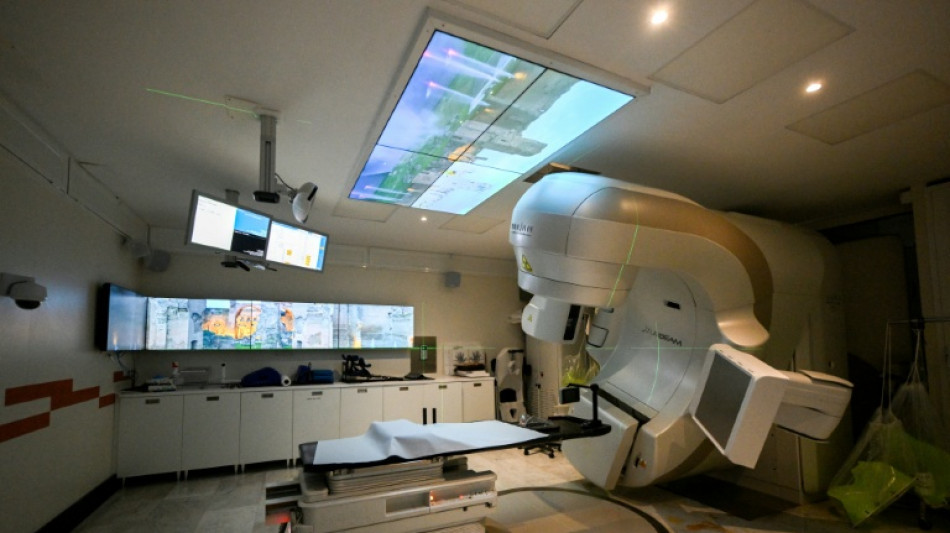
Rome hospital taps culture to help heal cancer patients / Photo: Tiziana FABI - AFP

 London
 9 °C

 Manchester
 8 °C
 Glasgow
8 °C
 Dublin
8 °C
 Belfast
11 °C
 Washington
 11 °C
 Denver
13 °C
 Atlanta
16 °C
 Dallas
17 °C
 Houston Texas
22 °C
 New Orleans
17 °C
 El Paso
20 °C
 Phoenix
27 °C
 Los Angeles
19 °C
San Diego
20 °C
San Francisco
16 °C
Chicago
13 °C
Minneapolis
12 °C
Seattle
9 °C
Portland
13 °C
Salt Lake City
14 °C
Las Vegas
23 °C
Miami
23 °C
Jacksonville
15 °C
San Antonio
17 °C
Bermuda
24 °C
Nassau
12 °C
Iqaluit
-5 °C
Yellowknife
4 °C
Anchorage
 2 °C
Fairbanks
 -3 °C
Barrow
-3 °C
Calgary
3 °C
Edmonton
8 °C
Winnipeg
9 °C
Goose Bay
3 °C
Halifax
 12 °C
Boston
9 °C
Ottawa
5 °C
Toronto
9 °C
Detroit
7 °C
Cleveland
8 °C
New York
12 °C
Baltimore
12 °C
Philadelphia
11 °C
Nuuk (Godthåb)
-5 °C
Hong Kong
 31 °C
Singapore
31 °C
Melbourne
21 °C
Canberra
 21 °C
Adelaide
27 °C
Darwin
34 °C
Perth
 22 °C
Fort Worth
17 °C
Honolulu
25 °C
Sydney
 23 °C
Johannesburg
18 °C
Dubai
33 °C
Mumbai
35 °C
Zürich
10 °C
Tokyo
28 °C
Seoul
16 °C
Delhi
29 °C
Beijing
16 °C
Riyadh
30 °C
Prague
6 °C
Pennsylvania
7 °C
Valletta
24 °C
Manama
32 °C
Warsaw
12 °C
Stockholm
10 °C
With art-filled treatment areas, museum tours and even ancient temple ruins on its grounds, a Rome hospital is hoping culture therapy will boost its cancer patients' "desire for life".
The small hospital on Tiberina Island, wedged between the city's Jewish Ghetto and its Trastevere neighbourhood, houses a state-of-the-art cancer treatment centre.
"When a cancer patient receives the diagnosis of their illness, it's a genuine existential earthquake," Vincenzo Valentini, the 73-year-old head of the hospital's oncology centre and coordinator of the project, told AFP.
Offering art to patients during their treatment is a way of trying to rebuild a "desire for life", said Valentini.
"Because art expresses life and so it means bringing life into places where people are afraid of losing it," he said.
Incorporating art into medical care "is not about sugarcoating care but is profoundly therapeutic".
Andrea Viani, 55, has undergone five rounds of radiotherapy at the hospital for a lung tumour diagnosed in May 2024.
"The beauty element helped me a lot because it helped my body relax, and a relaxed body repairs itself," Viani told AFP.
The Tiberina Island Gemelli hospital is part of the larger Gemelli Polyclinic near the Vatican where Pope Leo XIV underwent surgery for a cancerous tumour in his lung last week.
The island hospital is better known for its maternity ward.
Viani called it "a small, human-scale hospital" where "half of Rome's children" are born, he said.
- 'Resilience mechanisms' -
In the radiotherapy unit, a genuine 3rd-century BC shrine dedicated to Iuppiter Iurarius, or Jupiter the Guarantor of Oaths, can be seen through big picture windows.
Next to the benches where patients wait -- about 70 patients pass through the department every day -- shelves are filled with books about culture and there are works on the walls by a contemporary Neapolitan artist.
The art immersion -- a project launched in 2013 -- is not limited to the reception area.
Before entering the radiotherapy room, patients can use an interactive display to choose the music and images that will accompany their session -- usually lasting around 10 minutes.
While lying on the linear accelerator -- the imposing machine used to destroy cancer cells with an electron beam -- they can look at spectacular views of the Baths of Caracalla or the Colosseum on eight high-resolution screens arranged on the ceiling and walls.
By asking the patients to choose the images, "we try to activate their resilience mechanisms", said Francesco Micciche, 51, the head of the radiation oncology unit.
Outside the hospital, guided tours of emblematic monuments of the Eternal City are also offered to patients being treated for cancer and to their loved ones, such as the Colosseum or the Palazzo Colonna, a sumptuous aristocratic palace in the centre.
"A positive patient who knows how to be resilient -- that is, who can see the good even in a journey like oncology -- has a greater chance of recovery than others," Valentini said.
He hopes that in the long run it will be possible in Italy to "prescribe art as an instrument of healing" on a large scale, on the "social prescription" model in Britain to connect patients with non-medical services to help their care.
Patient Maddalena Palmieri, 42, vouched for the guided tours offered by the hospital.
"Days like these are really good for the mind. They let you get away, feel good and give yourself time," she said as she left her tour of the Palazzo Colonna.
Her cancer, she said, "made us realise that time is truly limited and that we must therefore make it precious".
(K.Lee--TAG)