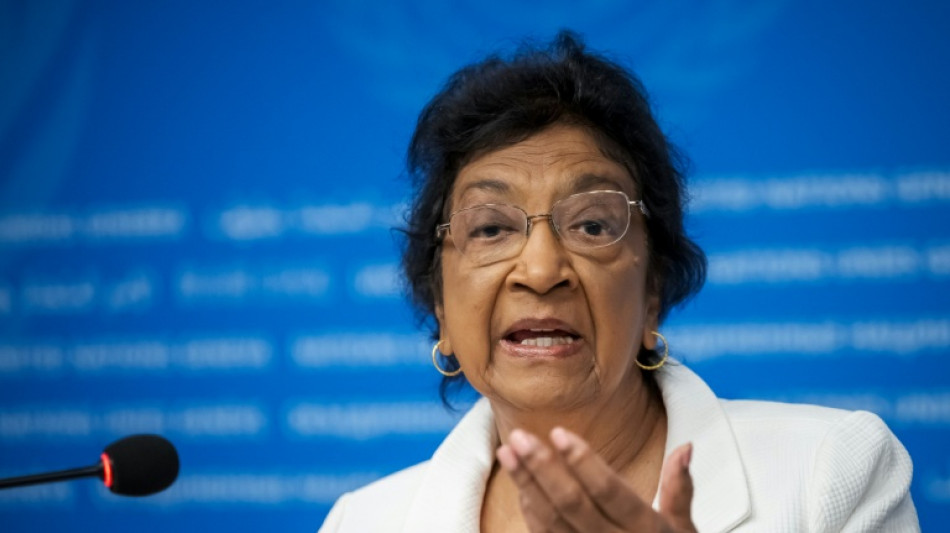
Navi Pillay: S.Africa's global rights activist and Nobel winner / Photo: Fabrice COFFRINI - AFP

 London
 18 °C
18 °C

 Manchester
 16 °C
16 °C
 Glasgow
11 °C
Glasgow
11 °C
 Dublin
 14 °C
14 °C
 Belfast
13 °C
Belfast
13 °C
 Washington
12 °C
Washington
12 °C
 Denver
 15 °C
15 °C
 Atlanta
18 °C
Atlanta
18 °C
 Dallas
20 °C
Dallas
20 °C
 Houston Texas
22 °C
Houston Texas
22 °C
 New Orleans
24 °C
New Orleans
24 °C
 El Paso
19 °C
El Paso
19 °C
 Phoenix
30 °C
Phoenix
30 °C
 Los Angeles
22 °C
San Diego
22 °C
San Francisco
14 °C
Chicago
15 °C
Minneapolis
9 °C
Seattle
13 °C
Portland
Los Angeles
22 °C
San Diego
22 °C
San Francisco
14 °C
Chicago
15 °C
Minneapolis
9 °C
Seattle
13 °C
Portland
 13 °C
Salt Lake City
18 °C
Las Vegas
25 °C
Miami
13 °C
Salt Lake City
18 °C
Las Vegas
25 °C
Miami
 27 °C
Jacksonville
24 °C
San Antonio
21 °C
Bermuda
26 °C
Nassau
14 °C
Iqaluit
0 °C
Yellowknife
2 °C
Anchorage
5 °C
Fairbanks
-4 °C
Barrow
-4 °C
Calgary
8 °C
Edmonton
11 °C
Winnipeg
6 °C
Goose Bay
10 °C
Halifax
7 °C
Boston
11 °C
Ottawa
7 °C
Toronto
27 °C
Jacksonville
24 °C
San Antonio
21 °C
Bermuda
26 °C
Nassau
14 °C
Iqaluit
0 °C
Yellowknife
2 °C
Anchorage
5 °C
Fairbanks
-4 °C
Barrow
-4 °C
Calgary
8 °C
Edmonton
11 °C
Winnipeg
6 °C
Goose Bay
10 °C
Halifax
7 °C
Boston
11 °C
Ottawa
7 °C
Toronto
 9 °C
Detroit
8 °C
Cleveland
8 °C
New York
14 °C
Baltimore
11 °C
Philadelphia
12 °C
Nuuk (Godthåb)
1 °C
Hong Kong
28 °C
Singapore
32 °C
Melbourne
25 °C
Canberra
14 °C
Adelaide
15 °C
Darwin
29 °C
Perth
17 °C
Fort Worth
20 °C
Honolulu
25 °C
Sydney
18 °C
Johannesburg
9 °C
Detroit
8 °C
Cleveland
8 °C
New York
14 °C
Baltimore
11 °C
Philadelphia
12 °C
Nuuk (Godthåb)
1 °C
Hong Kong
28 °C
Singapore
32 °C
Melbourne
25 °C
Canberra
14 °C
Adelaide
15 °C
Darwin
29 °C
Perth
17 °C
Fort Worth
20 °C
Honolulu
25 °C
Sydney
18 °C
Johannesburg
 28 °C
Dubai
39 °C
Mumbai
37 °C
Zürich
12 °C
Tokyo
22 °C
Seoul
21 °C
Delhi
35 °C
Beijing
20 °C
Riyadh
39 °C
Prague
11 °C
Pennsylvania
8 °C
Valletta
27 °C
Manama
36 °C
Warsaw
13 °C
Stockholm
8 °C
28 °C
Dubai
39 °C
Mumbai
37 °C
Zürich
12 °C
Tokyo
22 °C
Seoul
21 °C
Delhi
35 °C
Beijing
20 °C
Riyadh
39 °C
Prague
11 °C
Pennsylvania
8 °C
Valletta
27 °C
Manama
36 °C
Warsaw
13 °C
Stockholm
8 °C
Former UN rights chief Navi Pillay -- awarded the Nobel Peace Prize on Friday -- is a fearless global rights defender who has also served on the International Criminal Court and was South Africa's first non-white woman High Court judge.
The 85-year-old has built a formidable reputation during a decades-long career that took her from South African courts to the ICC and International Tribunal for Rwanda.
She gained global prominence for her outspoken condemnation of government repression of popular protests in the Arab world, including Libya and Syria.
Between 2021 and 2025, she chaired a commission of enquiry created by the UN Human Rights Council to probe the root causes of the Israeli-Palestinian conflict.
The panel, which does not speak for the UN and has faced harsh Israeli criticism, found that "genocide is occurring in Gaza and is continuing to occur", Pillay told AFP in 2025.
"The responsibility lies with the State of Israel," she said.
Pillay is currently an ad hoc judge at the International Court of Justice, working on a case deciding whether Myanmar's crackdown on the Rohingya breached the 1948 UN Genocide Convention, with a ruling expected in the coming months.
- Groundbreaking -
Born the daughter of a bus driver in South Africa's east coast city of Durban in 1941 to a family of Tamil descent, Pillay has had a groundbreaking career.
She grew up in a poor neighbourhood in the southeastern coastal city during white minority rule, and studied law at the University of Natal before attaining a Master's and Doctorate from Harvard.
She became the first non-white woman to open a law firm in Durban where she carved out a reputation as a doughty defender of apartheid opponents.
In 1973 she won the right for political prisoners in the notorious Robben Island penal colony –- where jailed anti-apartheid leader Nelson Mandela was held at the time -– to have access to lawyers.
A year after Mandela became president in South Africa's first democratic vote in 1994, she made legal history by becoming the first woman of colour to be appointed to the country’s high court.
Soon after, the late liberation hero recommended her to serve on a United Nations tribunal trying Rwandan genocide suspects.
In 1998, she was among judges on the Rwanda tribunal that was the first try rape as an act of genocide.
Ten years later, Pillay was appointed UN High Commissioner for Human Rights, a role she held until 2014.
- Voice of victims -
Her upbringing in an unjust aparthied society spurred her to fight discrimination everywhere and earned her the reputation of being the voice of victims around the world.
"We put up with the worst insults and racial discrimination and abused and treated like dirt," Pillay told AFP in an interview in 2023.
That could have made you "weak and cry" or "fight every step of the way", she said.
"So I always had a sense of confidence about who I am and how you confront any kind of discrimination. Open your mouth and speak up, condemning it. And that's what I did in the UN."
The rights defender married in 1965 lawyer Gaby Pillay, who was also a political prisoner she represented while he was tortured in detention during apartheid rule.
The couple divorced and Gaby died in the late 1990s. They had two daughters.
(L.Thomas--TAG)