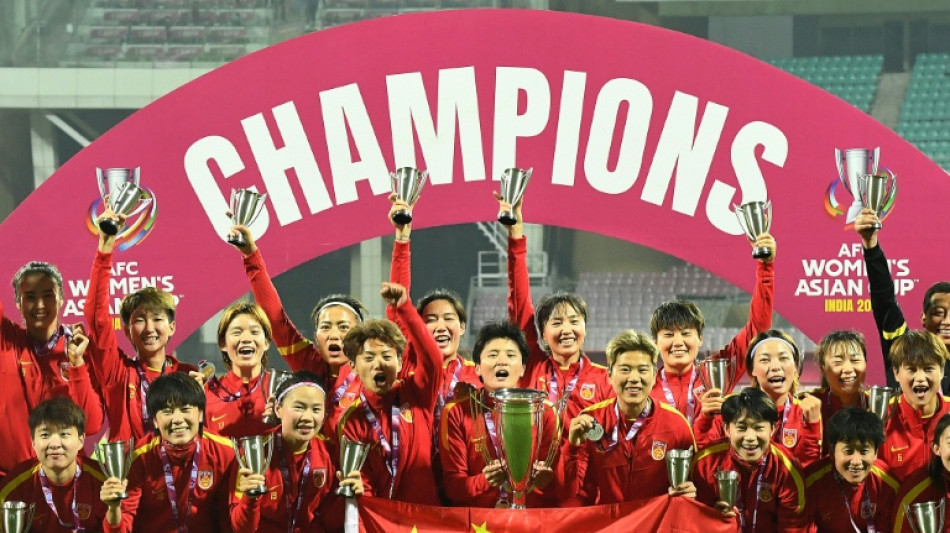
China chase glory days at Women's Asian Cup as Japan, Australia threat looms / Photo: INDRANIL MUKHERJEE - AFP

 London
 21 °C
21 °C

 Manchester
20 °C
Manchester
20 °C
 Glasgow
20 °C
Glasgow
20 °C
 Dublin
 18 °C
18 °C
 Belfast
18 °C
Belfast
18 °C
 Washington
23 °C
Washington
23 °C
 Denver
21 °C
Denver
21 °C
 Atlanta
 29 °C
29 °C
 Dallas
34 °C
Dallas
34 °C
 Houston Texas
 32 °C
32 °C
 New Orleans
31 °C
New Orleans
31 °C
 El Paso
25 °C
El Paso
25 °C
 Phoenix
 27 °C
27 °C
 Los Angeles
28 °C
San Diego
26 °C
San Francisco
Los Angeles
28 °C
San Diego
26 °C
San Francisco
 23 °C
Chicago
25 °C
Minneapolis
17 °C
Seattle
16 °C
Portland
18 °C
Salt Lake City
21 °C
Las Vegas
23 °C
Miami
26 °C
Jacksonville
31 °C
San Antonio
35 °C
Bermuda
29 °C
Nassau
21 °C
Iqaluit
3 °C
Yellowknife
6 °C
Anchorage
9 °C
Fairbanks
3 °C
Barrow
-3 °C
Calgary
17 °C
Edmonton
28 °C
Winnipeg
20 °C
Goose Bay
16 °C
Halifax
17 °C
Boston
18 °C
Ottawa
14 °C
Toronto
20 °C
Detroit
24 °C
Cleveland
23 °C
New York
21 °C
Baltimore
23 °C
Philadelphia
22 °C
Nuuk (Godthåb)
2 °C
Hong Kong
23 °C
Chicago
25 °C
Minneapolis
17 °C
Seattle
16 °C
Portland
18 °C
Salt Lake City
21 °C
Las Vegas
23 °C
Miami
26 °C
Jacksonville
31 °C
San Antonio
35 °C
Bermuda
29 °C
Nassau
21 °C
Iqaluit
3 °C
Yellowknife
6 °C
Anchorage
9 °C
Fairbanks
3 °C
Barrow
-3 °C
Calgary
17 °C
Edmonton
28 °C
Winnipeg
20 °C
Goose Bay
16 °C
Halifax
17 °C
Boston
18 °C
Ottawa
14 °C
Toronto
20 °C
Detroit
24 °C
Cleveland
23 °C
New York
21 °C
Baltimore
23 °C
Philadelphia
22 °C
Nuuk (Godthåb)
2 °C
Hong Kong
 29 °C
Singapore
29 °C
Singapore
 28 °C
Melbourne
31 °C
Canberra
3 °C
Adelaide
19 °C
Darwin
23 °C
Perth
28 °C
Melbourne
31 °C
Canberra
3 °C
Adelaide
19 °C
Darwin
23 °C
Perth
 14 °C
Fort Worth
34 °C
Honolulu
29 °C
Sydney
10 °C
Johannesburg
10 °C
Dubai
34 °C
Mumbai
27 °C
Zürich
19 °C
Tokyo
18 °C
Seoul
15 °C
Delhi
24 °C
Beijing
17 °C
Riyadh
33 °C
Prague
16 °C
Pennsylvania
22 °C
Valletta
24 °C
Manama
34 °C
Warsaw
14 °C
Stockholm
12 °C
14 °C
Fort Worth
34 °C
Honolulu
29 °C
Sydney
10 °C
Johannesburg
10 °C
Dubai
34 °C
Mumbai
27 °C
Zürich
19 °C
Tokyo
18 °C
Seoul
15 °C
Delhi
24 °C
Beijing
17 °C
Riyadh
33 °C
Prague
16 °C
Pennsylvania
22 °C
Valletta
24 °C
Manama
34 °C
Warsaw
14 °C
Stockholm
12 °C
Defending champions China are looking to recreate their glory days at the Women's Asian Cup, but the Steel Roses' hopes of a record 10th title face a daunting challenge from powerhouse Japan, hosts Australia and dark horse North Korea.
The 12-team competition gets underway on Sunday in the Western Australian city Perth when Sam Kerr's Matildas face the Philippines in a tournament organisers hope will create a similar buzz to the 2023 Women's World Cup.
That showcase, co-hosted by Australia and New Zealand, sparked massive public interest in women's football with strong crowds and television audiences.
While the Asian Cup is not the World Cup, organising committee chief Sarah Walsh, a former Australian international, still has high hopes, saying it will "absolutely be the biggest Women's Asian Cup ever".
Walsh stressed the event was also about helping further break down barriers for women on a continent where gender equality can sometimes lag.
"We have a responsibility as hosts ... to make sure that this isn't just 21 days of fun but that we are progressing the development of the countries that are playing in the finals," she said.
China edged South Korea 3-2 in Mumbai four years ago to win their ninth Asian Cup and are the most successful team in the competition's history.
But the days when they were among the world elite are long gone with results since lifting the trophy in India disappointing.
Coach Ante Milicic, a seasoned campaigner who led Australia at the 2019 World Cup, admitted it will be a "massive challenge" to secure back-to-back crowns for a team that has slumped to 17 in the world.
"Of course there's more added pressure now because in the past they've been used to a little bit of success," he said. "Now we have an opportunity to see what we can do to produce players and teams that the nation can be proud of."
China gets underway against Bangladesh in Sydney on Tuesday. They are also grouped with Uzbekistan and three-time winners and ninth-ranked North Korea.
North Korea, which remains largely closed off to the outside world, are back at the tournament for the first time since finishing runners-up in 2010 with a squad boosting an exciting new generation of talent.
- Final prize -
Coached by the experienced Ri Song Ho, their squad includes several players who helped win the Women's U-17 World Cup last year. That triumph came on the back of winning the Women's U-20 World Cup in 2024.
They kick off against Uzbekistan on Tuesday.
Japan, the highest ranked team at eight, are the only Asian country to have won the World Cup. But they have only lifted the continental title twice in 20 editions, most recently 2018.
Spearheaded by Manchester United's Hinata Miyazawa and Manchester City pair Yui Hasegawa and Aoba Fujino, they are grouped with Vietnam, India, and Taiwan and kick-off in Perth on Wednesday.
"It is not a tournament that has been easy to win for Japan historically," said Greenlander Nils Nielsen, the first foreign-born coach of the Japan women's team.
"We want to make new history."
Australia, the 2010 winners and runners-up in 2014 and 2018, have their work cut out after being pitted with South Korea, Iran and the Philippines.
But they have a strong squad packed with English-based stars including Steph Catley, Ellie Carpenter, and Caitlin Foord, while Chelsea's Kerr is at her fifth Asian Cup.
The top two sides from each of the three groups, along with the two best third-placed teams, progress to the quarter-finals, with the top six finishers booking their tickets to the 2027 World Cup in Brazil.
(F.Jackson--TAG)