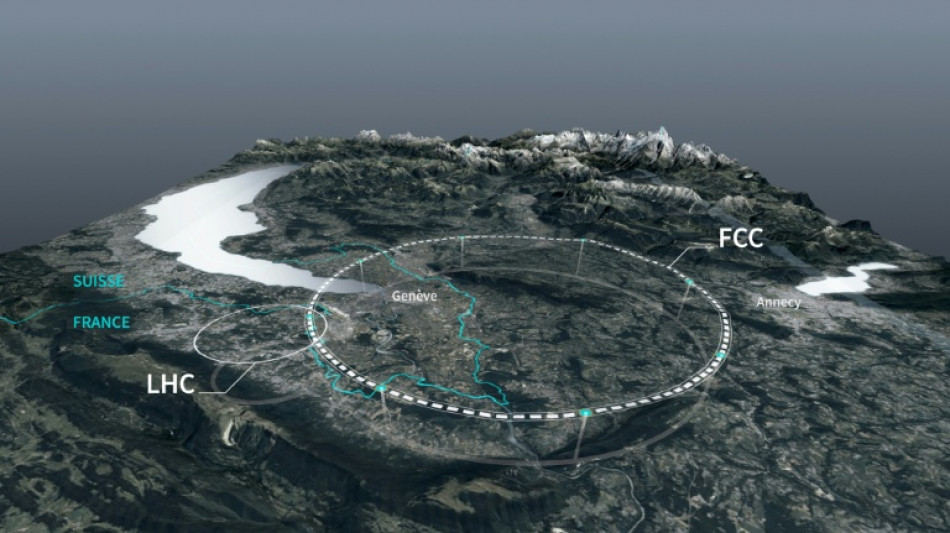
Private donors pledge $1 bn for CERN particle accelerator / Photo: HANDOUT - European Organization for Nuclear Research (CERN)/AFP/File

 London
 21 °C
21 °C

 Manchester
 14 °C
14 °C
 Glasgow
17 °C
Glasgow
17 °C
 Dublin
14 °C
Dublin
14 °C
 Belfast
13 °C
Belfast
13 °C
 Washington
30 °C
Washington
30 °C
 Denver
21 °C
Denver
21 °C
 Atlanta
34 °C
Atlanta
34 °C
 Dallas
 38 °C
38 °C
 Houston Texas
36 °C
Houston Texas
36 °C
 New Orleans
 35 °C
35 °C
 El Paso
36 °C
El Paso
36 °C
 Phoenix
41 °C
Phoenix
41 °C
 Los Angeles
27 °C
San Diego
26 °C
San Francisco
Los Angeles
27 °C
San Diego
26 °C
San Francisco
 19 °C
Chicago
25 °C
Minneapolis
27 °C
Seattle
25 °C
Portland
22 °C
Salt Lake City
31 °C
Las Vegas
32 °C
Miami
32 °C
Jacksonville
34 °C
San Antonio
38 °C
Bermuda
25 °C
Nassau
26 °C
Iqaluit
10 °C
Yellowknife
19 °C
Chicago
25 °C
Minneapolis
27 °C
Seattle
25 °C
Portland
22 °C
Salt Lake City
31 °C
Las Vegas
32 °C
Miami
32 °C
Jacksonville
34 °C
San Antonio
38 °C
Bermuda
25 °C
Nassau
26 °C
Iqaluit
10 °C
Yellowknife
 12 °C
Anchorage
19 °C
Fairbanks
23 °C
Barrow
17 °C
Calgary
23 °C
Edmonton
34 °C
Winnipeg
22 °C
Goose Bay
22 °C
Halifax
23 °C
Boston
24 °C
Ottawa
24 °C
Toronto
23 °C
Detroit
26 °C
Cleveland
27 °C
New York
28 °C
Baltimore
29 °C
Philadelphia
30 °C
Nuuk (Godthåb)
8 °C
Hong Kong
29 °C
Singapore
12 °C
Anchorage
19 °C
Fairbanks
23 °C
Barrow
17 °C
Calgary
23 °C
Edmonton
34 °C
Winnipeg
22 °C
Goose Bay
22 °C
Halifax
23 °C
Boston
24 °C
Ottawa
24 °C
Toronto
23 °C
Detroit
26 °C
Cleveland
27 °C
New York
28 °C
Baltimore
29 °C
Philadelphia
30 °C
Nuuk (Godthåb)
8 °C
Hong Kong
29 °C
Singapore
 28 °C
Melbourne
31 °C
Canberra
8 °C
Adelaide
10 °C
Darwin
24 °C
Perth
12 °C
Fort Worth
39 °C
Honolulu
27 °C
Sydney
13 °C
Johannesburg
9 °C
Dubai
35 °C
Mumbai
27 °C
Zürich
28 °C
Melbourne
31 °C
Canberra
8 °C
Adelaide
10 °C
Darwin
24 °C
Perth
12 °C
Fort Worth
39 °C
Honolulu
27 °C
Sydney
13 °C
Johannesburg
9 °C
Dubai
35 °C
Mumbai
27 °C
Zürich
 24 °C
Tokyo
24 °C
Seoul
24 °C
Delhi
29 °C
Beijing
22 °C
Riyadh
35 °C
Prague
23 °C
Pennsylvania
30 °C
Valletta
24 °C
Tokyo
24 °C
Seoul
24 °C
Delhi
29 °C
Beijing
22 °C
Riyadh
35 °C
Prague
23 °C
Pennsylvania
30 °C
Valletta
 28 °C
Manama
35 °C
Warsaw
21 °C
Stockholm
20 °C
28 °C
Manama
35 °C
Warsaw
21 °C
Stockholm
20 °C
Europe's physics lab CERN on Thursday said private donors had pledged $1 billion towards the construction of a new particle accelerator that would be by far the world's biggest.
In a first, private individuals and philanthropic foundations have backed a flagship research project at CERN, the European Organization for Nuclear Research, which seeks to unravel what the universe is made of and how it works.
The donors include the Breakthrough Prize Foundation of billionaire Silicon Valley investor Yuri Milner; the Eric and Wendy Schmidt Fund for Strategic Innovation of former Google chief executive Eric Schmidt; plus Italian Agnelli family heir John Elkann, and French telecoms tycoon Xavier Niel.
"It's the first time in history that private donors wish to partner with CERN to build an extraordinary research instrument that will allow humanity to take major steps forward in our understanding of fundamental physics," said CERN Director-General Fabiola Gianotti.
CERN's Large Hadron Collider (LHC) is currently the world's biggest particle accelerator, whizzing particles into each other at phenomenal speeds.
The 27-kilometre (16.8-mile) proton-smashing ring, running about 100 metres (330 feet) below France and Switzerland, has, among other things, been used to prove the existence of the Higgs boson.
Dubbed "the God particle", its discovery in 2012 broadened science's understanding of how particles acquire mass and earned physicists Peter Higgs and Francois Englert the 2013 Nobel Prize for Physics.
The LHC is expected to have fully run its course by around 2040, and CERN is considering building a far larger collider to allow scientists to keep pushing the boundaries of knowledge.
The planned Future Circular Collider (FCC) would be a ring with a circumference of 91 km and an average depth of 200 metres.
Scientists believe that ordinary matter -- such as stars, gases, dust, planets and everything on them -- accounts for just five percent of the universe.
The FCC will try to reveal what makes up the other 95 percent of the energy and matter in the universe -- so-called dark matter and dark energy, which scientists have yet to observe directly.
The gigantic project, estimated to cost around $17 billion, has not yet received the green light from CERN's 25 member states.
CERN, located on the outskirts of Geneva, is set to take a decision in 2028.
"The FCC is an instrument that could push the boundaries of human knowledge," Eric Schmidt in the statement.
"Beyond the science, the technologies emerging from this project could benefit society in profound ways, from medicine to computing to sustainable energy."
S. Pete Worden, chairman of the Breakthrough Prize Foundation, said the FCC would be "the most powerful scientific instrument in history, that can shed new light on the deepest questions humanity can ask".
(C.Young--TAG)