Europe bids to be robot superpower like US, China / Photo: Tobias SCHWARZ - POOL/AFP/File

 London
 26 °C
26 °C

 Manchester
22 °C
Manchester
22 °C
 Glasgow
 19 °C
19 °C
 Dublin
20 °C
Dublin
20 °C
 Belfast
20 °C
Belfast
20 °C
 Washington
26 °C
Washington
26 °C
 Denver
 20 °C
20 °C
 Atlanta
29 °C
Atlanta
29 °C
 Dallas
27 °C
Dallas
27 °C
 Houston Texas
28 °C
Houston Texas
28 °C
 New Orleans
30 °C
New Orleans
30 °C
 El Paso
 27 °C
27 °C
 Phoenix
30 °C
Phoenix
30 °C
 Los Angeles
19 °C
San Diego
18 °C
San Francisco
Los Angeles
19 °C
San Diego
18 °C
San Francisco
 16 °C
Chicago
30 °C
Minneapolis
25 °C
Seattle
13 °C
Portland
13 °C
Salt Lake City
17 °C
Las Vegas
24 °C
Miami
31 °C
Jacksonville
29 °C
San Antonio
28 °C
Bermuda
30 °C
Nassau
23 °C
Iqaluit
10 °C
Yellowknife
16 °C
Anchorage
8 °C
Fairbanks
-1 °C
Barrow
1 °C
Calgary
14 °C
Edmonton
28 °C
Winnipeg
18 °C
Goose Bay
22 °C
Halifax
21 °C
Boston
19 °C
Ottawa
22 °C
Toronto
23 °C
Detroit
27 °C
Cleveland
27 °C
New York
23 °C
Baltimore
25 °C
Philadelphia
25 °C
Nuuk (Godthåb)
6 °C
Hong Kong
29 °C
Singapore
16 °C
Chicago
30 °C
Minneapolis
25 °C
Seattle
13 °C
Portland
13 °C
Salt Lake City
17 °C
Las Vegas
24 °C
Miami
31 °C
Jacksonville
29 °C
San Antonio
28 °C
Bermuda
30 °C
Nassau
23 °C
Iqaluit
10 °C
Yellowknife
16 °C
Anchorage
8 °C
Fairbanks
-1 °C
Barrow
1 °C
Calgary
14 °C
Edmonton
28 °C
Winnipeg
18 °C
Goose Bay
22 °C
Halifax
21 °C
Boston
19 °C
Ottawa
22 °C
Toronto
23 °C
Detroit
27 °C
Cleveland
27 °C
New York
23 °C
Baltimore
25 °C
Philadelphia
25 °C
Nuuk (Godthåb)
6 °C
Hong Kong
29 °C
Singapore
 29 °C
Melbourne
28 °C
Canberra
10 °C
Adelaide
29 °C
Melbourne
28 °C
Canberra
10 °C
Adelaide
 12 °C
Darwin
27 °C
Perth
17 °C
Fort Worth
27 °C
Honolulu
12 °C
Darwin
27 °C
Perth
17 °C
Fort Worth
27 °C
Honolulu
 25 °C
Sydney
15 °C
Johannesburg
25 °C
Dubai
37 °C
Mumbai
25 °C
Sydney
15 °C
Johannesburg
25 °C
Dubai
37 °C
Mumbai
 29 °C
Zürich
28 °C
Tokyo
27 °C
Seoul
25 °C
Delhi
31 °C
Beijing
20 °C
Riyadh
40 °C
Prague
23 °C
Pennsylvania
23 °C
Valletta
34 °C
Manama
37 °C
Warsaw
23 °C
Stockholm
19 °C
29 °C
Zürich
28 °C
Tokyo
27 °C
Seoul
25 °C
Delhi
31 °C
Beijing
20 °C
Riyadh
40 °C
Prague
23 °C
Pennsylvania
23 °C
Valletta
34 °C
Manama
37 °C
Warsaw
23 °C
Stockholm
19 °C
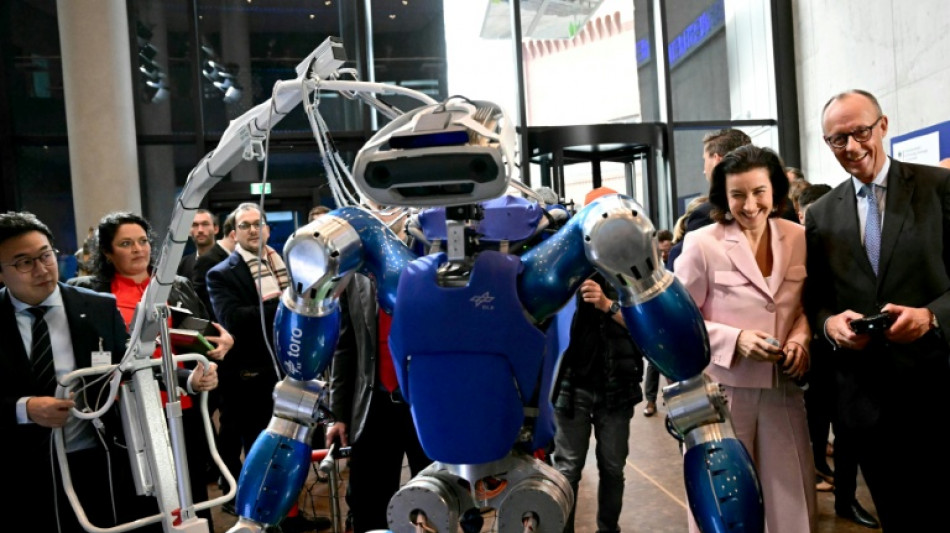
AI-powered robots briefly took over the European Parliament this week to showcase the continent's creators as the bloc races to compete in a field dominated by China and the United States.
As some machines demonstrated their ability to clean or recycle objects, others showed they could deliver parcels during a live demonstration in Brussels.
Four human-assistance robots, designed by France's INRIA research institute and the German Aerospace Centre (DLR) among others, cleared a breakfast table in 10 minutes.
One robot tidied cupboards and wiped surfaces, while others put orange juice and milk in the fridge, threw away empty packaging and loaded the dishwasher.
The robots moved slowly and sometimes required a few attempts to complete their tasks.
But that is by design, said INRIA's Serena Ivaldi, as the robots "have to act in human environments" without startling the people they help.
The robots are made to prioritise precision over speed.
Only a few metres away, a multi-jointed robotic arm developed by France's CEA research agency dismantled an electric battery model for recycling.
To become a bigger power in robotics, experts say Europe needs more investments.
"Europe has generated a lot of the science and research that actually allowed some of the successful cases in China and in the US," Portuguese robotics researcher Pedro Lima told AFP.
But what Europe lacks is "definitely political will and funding", he added.
- 'Transformer' -
KYON, a quadruped robot reminiscent of ones seen in the dystopian TV series "Black Mirror", made its public debut during the showcase, bending its legs to pick up a parcel before taking several steps to deliver it to a human.
The robot has been developed by the Italian Institute of Technology (IIT) for use in logistics.
Another robot, ETH Zurich's aptly-named "Transformer", moved its robotic limbs swiftly to change both shape and function: it switched from being on four legs to two legs without losing balance, before returning on all fours, and climbing up and down stairs with ease.
The demonstrations aimed to showcase Europe's significant strengths in robotics thanks to many public and private research institutes, as well as start-ups and industrial groups.
"The vision we have is that in 10 years Europe should have a major robotic industry branch of the size and importance of the current automotive industry," said Alin Albu-Schaeffer, coordinator of the EU-funded euROBin network, which organised the event at the EU parliament.
Europe could capture one-third of the global intelligent robotics market by then, he added.
That is highly ambitious, as China has invested heavily in humanoid robots and recently staged a show of technological prowess at the World Robot Games in Beijing, where one of its machines broke Jamaican legend Usain Bolt's record for the 100-metre dash.
"We are too often good at inventing technologies but too slow at turning them into global companies," said EU lawmaker Axel Voss, who has pushed for Europe's technological sovereignty.
"Robotics is extremely important for us today and for Europe tomorrow, and Europe is facing a choice," said Voss, warning that the "United States and China are scaling faster, capital is flowing elsewhere".
"We can watch the next industrial revolution happen elsewhere or we can decide that Europe will shape it," he said.
(O.Robinson--TAG)