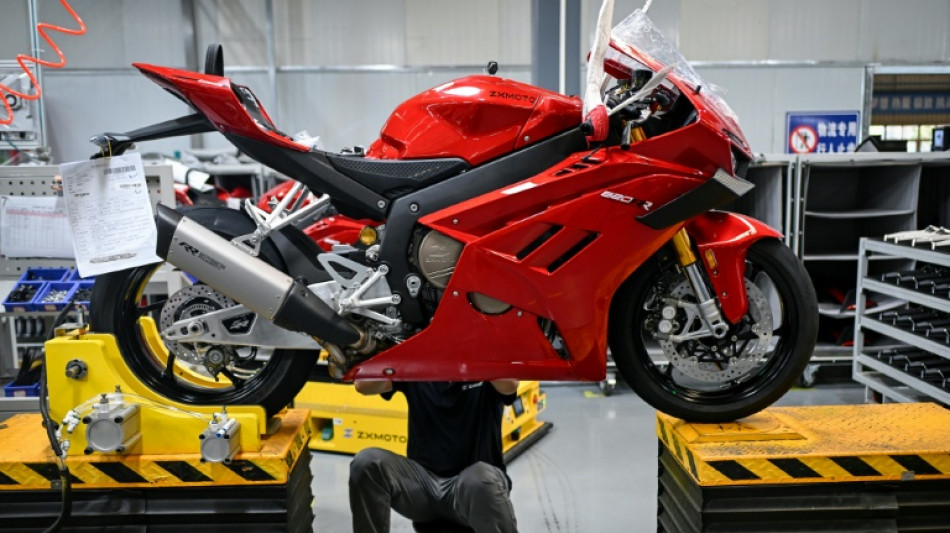
ZXMoto leads China's charge to dominate the global motorbike market / Photo: WANG Zhao - AFP/File

 London
 17 °C
17 °C

 Manchester
 15 °C
15 °C
 Glasgow
 14 °C
14 °C
 Dublin
16 °C
Dublin
16 °C
 Belfast
14 °C
Belfast
14 °C
 Washington
 16 °C
16 °C
 Denver
14 °C
Denver
14 °C
 Atlanta
 14 °C
14 °C
 Dallas
23 °C
Dallas
23 °C
 Houston Texas
 24 °C
24 °C
 New Orleans
21 °C
New Orleans
21 °C
 El Paso
21 °C
El Paso
21 °C
 Phoenix
28 °C
Phoenix
28 °C
 Los Angeles
20 °C
San Diego
20 °C
San Francisco
14 °C
Chicago
13 °C
Minneapolis
15 °C
Seattle
9 °C
Portland
10 °C
Salt Lake City
19 °C
Las Vegas
27 °C
Miami
Los Angeles
20 °C
San Diego
20 °C
San Francisco
14 °C
Chicago
13 °C
Minneapolis
15 °C
Seattle
9 °C
Portland
10 °C
Salt Lake City
19 °C
Las Vegas
27 °C
Miami
 24 °C
Jacksonville
16 °C
San Antonio
25 °C
Bermuda
28 °C
Nassau
13 °C
Iqaluit
2 °C
Yellowknife
6 °C
Anchorage
8 °C
Fairbanks
5 °C
Barrow
-2 °C
Calgary
6 °C
Edmonton
12 °C
Winnipeg
17 °C
Goose Bay
12 °C
Halifax
13 °C
Boston
14 °C
Ottawa
10 °C
Toronto
12 °C
Detroit
12 °C
Cleveland
10 °C
New York
14 °C
Baltimore
17 °C
Philadelphia
15 °C
Nuuk (Godthåb)
0 °C
Hong Kong
30 °C
Singapore
24 °C
Jacksonville
16 °C
San Antonio
25 °C
Bermuda
28 °C
Nassau
13 °C
Iqaluit
2 °C
Yellowknife
6 °C
Anchorage
8 °C
Fairbanks
5 °C
Barrow
-2 °C
Calgary
6 °C
Edmonton
12 °C
Winnipeg
17 °C
Goose Bay
12 °C
Halifax
13 °C
Boston
14 °C
Ottawa
10 °C
Toronto
12 °C
Detroit
12 °C
Cleveland
10 °C
New York
14 °C
Baltimore
17 °C
Philadelphia
15 °C
Nuuk (Godthåb)
0 °C
Hong Kong
30 °C
Singapore
 32 °C
Melbourne
20 °C
Canberra
19 °C
Adelaide
14 °C
Darwin
29 °C
Perth
17 °C
Fort Worth
22 °C
Honolulu
26 °C
Sydney
20 °C
Johannesburg
25 °C
Dubai
36 °C
Mumbai
31 °C
Zürich
20 °C
Tokyo
19 °C
Seoul
24 °C
Delhi
28 °C
Beijing
25 °C
Riyadh
41 °C
Prague
17 °C
Pennsylvania
16 °C
Valletta
24 °C
Manama
38 °C
Warsaw
15 °C
Stockholm
32 °C
Melbourne
20 °C
Canberra
19 °C
Adelaide
14 °C
Darwin
29 °C
Perth
17 °C
Fort Worth
22 °C
Honolulu
26 °C
Sydney
20 °C
Johannesburg
25 °C
Dubai
36 °C
Mumbai
31 °C
Zürich
20 °C
Tokyo
19 °C
Seoul
24 °C
Delhi
28 °C
Beijing
25 °C
Riyadh
41 °C
Prague
17 °C
Pennsylvania
16 °C
Valletta
24 °C
Manama
38 °C
Warsaw
15 °C
Stockholm
 14 °C
14 °C
Zhang Xue wept with joy and furiously waved a Chinese flag as he watched his company's superbike scream across the finish line four seconds ahead of competitors in only its third world championship race.
That victory at the Supersport World Championship in March saw orders for ZXMoto's two-wheelers skyrocket and provided a boost for the firm as it battles for an edge in the highly competitive Chinese motorbike market.
The company was founded just two years ago but already rivals leading manufacturers such as Europe's Ducati and Japanese giants Yamaha and Honda with a bike retailing for a fraction of their prices.
"You have this dream you've been thinking about for many years, and when it finally comes true... I was so happy," Zhang, 39, told AFP at his company's headquarters in Chongqing.
ZXMoto has doubled its workforce since March and its factory runs 24-hours a day to meet demand, but customers still wait months for orders.
"Chinese brands are very clear about where our future lies," said Zhang, a former mechanic who claims he can assemble an engine with his eyes closed.
"It has to be global."
The firm's flagship 133-horsepower 820RR motorbike -- which accelerates from zero to 100 kilometres and hour in 2.8 seconds -- sells for around 43,000 yuan ($6,370) in China, at least 30 percent cheaper than foreign rivals.
"Compared to imported ones like Kawasaki, it's very good value," said 28-year-old rider Yang, who owns an 820RR.
"First off, we support domestic production, and second, if the product is truly good, we'll choose it."
Sales have soared from 25,000 bikes in 2025 to a projected 100,000 this year, with plans to double that figure by 2027 -– a target on par with BMW's scope.
However, it faces a shrinking domestic market, vicious competition and squeezed profits.
- Fan loyalty -
"Twenty years ago, as long as you produced a motorcycle, even if it didn't start, people would line up to give you money," Zhang said.
"Now... If you don't get serious, you will be eliminated by the market."
China's motorbike sales fell 3.4 percent in 2025, and slid again this year as consumers increasingly favour cars or less regulated electric bikes.
In China, Zhang can rely on loyal fans who see him as a symbol of the country's manufacturing prowess, drawn by his rags-to-riches background.
"Zhang Xue has brought glory to China, so I want to support him," said Hu Zhaomeng, picking up his gleaming red 500 model from a Chongqing dealership.
But weakening domestic sales are pushing manufacturers like Zhang to seek fatter margins abroad, where consumers have more purchasing power.
Half of the 22 million motorcycles produced in China last year were exported, and nearly all brands are looking overseas.
Zhang hopes to export 40,000 bikes to Europe in 2027, while rival manufacturer Shineray sells 90 percent of its low-end models to South America, Southeast Asia, and Africa.
"The domestic market situation is very 'juan'," said Shineray's overseas marketing head Nie Jianwei, using a Chinese buzzword for extreme competition.
"We are constantly reducing the price of our products to make them more competitive."
In Chongqing, more than 50 manufacturers and hundreds of component suppliers are able to leverage the booming industry of China's "motorbike capital".
"Companies like ZXMoto are emerging from one of the world's most competitive industrial ecosystems, where rapid iteration, integrated supply chains, and relentless competition yield world-class products rapidly," said Bill Russo, an expert in China's automotive industry.
- Prestige and heritage -
Zhang told AFP the city's cheaper production costs offer Chinese brands "a greater advantage" over Japanese or European rivals.
"They have reached a (technological) ceiling, so they can only wait for me there... the speed of their progress is limited."
For Russo, "the motorcycle industry today reminds me of where China's passenger car industry stood roughly a decade ago".
Chinese auto giants like BYD and Geely eventually out-competed established foreign rivals on price and are increasingly at the industry's technological forefront.
However, two-wheelers may prove a more resilient market to break into.
"Motorcycles remain more emotionally driven purchases than cars. Heritage, racing history and brand prestige still matter much more, giving established Japanese and European manufacturers a stronger defensive position," Russo said.
"The gap is closing, but it won't close overnight."
Still, momentum is building, and ZXMoto expects to sell most of its production overseas within five years.
Russo expects Chinese brands to establish a larger global footprint through local investments and partnerships rather than exports alone.
With an 800-million-yuan factory opening in late 2027, ZXMoto is on track to become one of the world's top 10 motorcycle brands by 2034.
"When Japanese products first entered Europe, there was the same reaction, there were many questions," Zhang said, over the roar of engines being tested.
"But as long as the products are good, one day people will accept and enjoy them."
(C.Young--TAG)