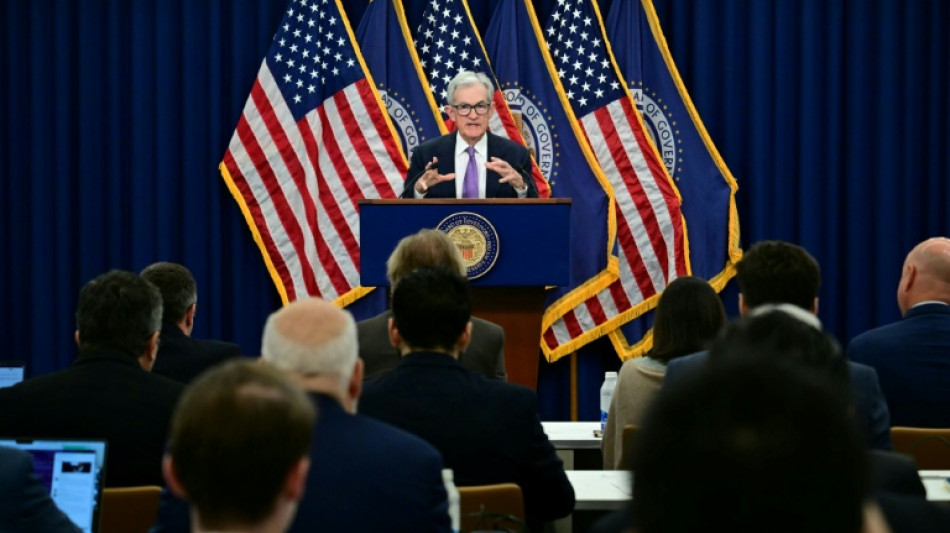
Divided US Fed makes third straight rate cut, signals higher bar ahead / Photo: Jim WATSON - AFP/File

 London
 22 °C
22 °C
 Manchester
 19 °C
19 °C
 Glasgow
 14 °C
14 °C
 Dublin
19 °C
Dublin
19 °C
 Belfast
19 °C
Belfast
19 °C
 Washington
 28 °C
28 °C
 Denver
18 °C
Denver
18 °C
 Atlanta
 22 °C
22 °C
 Dallas
28 °C
Dallas
28 °C
 Houston Texas
27 °C
Houston Texas
27 °C
 New Orleans
27 °C
New Orleans
27 °C
 El Paso
28 °C
El Paso
28 °C
 Phoenix
30 °C
Phoenix
30 °C
 Los Angeles
18 °C
San Diego
18 °C
San Francisco
12 °C
Chicago
21 °C
Minneapolis
20 °C
Seattle
14 °C
Portland
16 °C
Salt Lake City
20 °C
Las Vegas
26 °C
Miami
Los Angeles
18 °C
San Diego
18 °C
San Francisco
12 °C
Chicago
21 °C
Minneapolis
20 °C
Seattle
14 °C
Portland
16 °C
Salt Lake City
20 °C
Las Vegas
26 °C
Miami
 26 °C
Jacksonville
23 °C
San Antonio
26 °C
Bermuda
24 °C
Nassau
25 °C
Iqaluit
5 °C
Yellowknife
14 °C
Anchorage
10 °C
Fairbanks
12 °C
Barrow
1 °C
Calgary
14 °C
Edmonton
19 °C
Winnipeg
14 °C
Goose Bay
22 °C
Halifax
24 °C
Boston
26 °C
Ottawa
21 °C
Toronto
23 °C
Detroit
22 °C
Cleveland
22 °C
New York
25 °C
Baltimore
28 °C
Philadelphia
25 °C
Nuuk (Godthåb)
5 °C
Hong Kong
27 °C
Singapore
31 °C
Melbourne
25 °C
Canberra
6 °C
Adelaide
11 °C
Darwin
28 °C
Perth
17 °C
Fort Worth
26 °C
Jacksonville
23 °C
San Antonio
26 °C
Bermuda
24 °C
Nassau
25 °C
Iqaluit
5 °C
Yellowknife
14 °C
Anchorage
10 °C
Fairbanks
12 °C
Barrow
1 °C
Calgary
14 °C
Edmonton
19 °C
Winnipeg
14 °C
Goose Bay
22 °C
Halifax
24 °C
Boston
26 °C
Ottawa
21 °C
Toronto
23 °C
Detroit
22 °C
Cleveland
22 °C
New York
25 °C
Baltimore
28 °C
Philadelphia
25 °C
Nuuk (Godthåb)
5 °C
Hong Kong
27 °C
Singapore
31 °C
Melbourne
25 °C
Canberra
6 °C
Adelaide
11 °C
Darwin
28 °C
Perth
17 °C
Fort Worth
 28 °C
Honolulu
24 °C
Sydney
11 °C
Johannesburg
12 °C
Dubai
35 °C
Mumbai
27 °C
Zürich
24 °C
Tokyo
26 °C
Seoul
27 °C
Delhi
41 °C
Beijing
35 °C
Riyadh
42 °C
Prague
20 °C
Pennsylvania
25 °C
Valletta
30 °C
Manama
35 °C
Warsaw
17 °C
Stockholm
18 °C
28 °C
Honolulu
24 °C
Sydney
11 °C
Johannesburg
12 °C
Dubai
35 °C
Mumbai
27 °C
Zürich
24 °C
Tokyo
26 °C
Seoul
27 °C
Delhi
41 °C
Beijing
35 °C
Riyadh
42 °C
Prague
20 °C
Pennsylvania
25 °C
Valletta
30 °C
Manama
35 °C
Warsaw
17 °C
Stockholm
18 °C
A divided US Federal Reserve lowered interest rates Wednesday for a third consecutive time this year, flagging labor market concerns even as inflation remained elevated as President Donald Trump's tariffs bite.
But Fed Chair Jerome Powell signaled a higher bar for future reductions, saying the central bank is "well positioned to wait and see how the economy evolves from here."
He told a press briefing that officials are in a good position to determine the "extent and timing of additional adjustments based on the incoming data, the evolving outlook and the balance of risks."
Wednesday's cut by a quarter percentage point brings rates to a range between 3.50 percent and 3.75 percent, the lowest in around three years, a move aligned with market expectations.
The Fed penciled in one more rate cut next year, and flagged heightened risks to employment as it announced its latest decision.
But a rift within the central bank deepened with three officials voting against the modest reduction.
Chicago Fed president Austan Goolsbee and Kansas City Fed president Jeffrey Schmid instead sought to keep rates unchanged. Fed Governor Stephen Miran backed a bigger, half-percentage-point cut.
The Fed's rate-setting committee consists of 12 voting members -- including seven members of the board of governors, the New York Fed president and a rotation of reserve bank presidents -- who take a majority vote in deciding the path of rates.
- 'Close call' -
Powell noted that some disagreement was expected, pointing to tensions between inflation risks and a weakening jobs market.
"It's a close call," he said.
For now, he added, the Fed is "in the range of neutral" rates, with neutral being a level that neither stimulates nor restricts economic activity.
The fed has previously described interest rates as "restrictive" -- "neutral" could suggest less justification to lower levels quickly.
Powell added that the US economy needs several years where wages are higher than inflation for "people to start feeling good about affordability."
On Wednesday, Fed officials also lifted their 2026 GDP growth forecast to 2.3 percent, from 1.8 percent previously.
They eased their inflation expectations slightly for the next year, and kept unemployment rate expectations unchanged.
These projections could shift as the central bank grapples with a delay in federal economic data releases after a record-long government shutdown.
A contentious meeting that has multiple dissents is a "normal and healthy" sign, said Ryan Sweet of Oxford Economics.
Still, "more cuts now imply fewer later," he added in a note before the latest announcement.
"The central bank will want time to gauge how past cuts are impacting the economy," he said.
- Turbulent 2026 -
This week's gathering is the last before 2026, a year of key changes for the bank. A new chief will arrive after Powell's term ends in May, while political pressure mounts.
Miran's term expires in January, creating an opening among the Fed's top leadership, and Trump has sought to free up another seat by attempting to fire Fed Governor Lisa Cook.
Cook has challenged her ousting and the case remains before the courts -- she continues to carry out her role in the meantime.
In a Politico interview published Tuesday, Trump signaled he would judge Powell's successor on whether they immediately cut rates.
Interviews for his choice are entering the final stages, with Trump's chief economic adviser Kevin Hassett among top contenders.
Others include former Fed official Kevin Warsh, Fed governors Christopher Waller and Michelle Bowman, and Rick Rieder of BlackRock.
"The challenge facing the Fed next year is the potential jobless expansion, when GDP increases but employment gains are modest, at best," Sweet said.
"This leaves the economy vulnerable to shocks because the labor market is the main firewall against a recession," he said.
(P.Davis--TAG)